
If you are looking for a calm and attractive summer spot where tourism is not as developed as in other coastal towns, Split can be a great city to visit on the Dalmatian coast of Croatia.
Located in the central area of the country, Split is a perfect starting point to visit many other towns in the country as well as unique natural sites, such as the northern Plitvice Lakes, near Zagreb, or the southern Elaphite Islands, near Dubrovnik.
In this article, I have listed the best things to do in Split for an unforgettable time in town. Take a look!
What to Know About Split
Right after the capital, Zagreb, Split is the second most important city in Croatia, the larger town on the Dalmatian coast located on the eastern shore of the Adriatic Sea.
The city is developed over a central peninsula, and it’s one of the country’s most strategic transport hubs, with an airport and ferries reaching many islands on the Adriatic.
In the past, about the second century AD, the city was a Greek colony and later an important city of the Roman Empire.
With the fall of the empire, Split became an important Byzantine city, which in later years fell under the rule of the Republic of Venice.
As such, it remained for many years, becoming a heavily fortified outpost surrounded by Ottoman territory.
In the more recent past, Split was part of the Austrian Kingdom of Dalmatia, and during WWII, it was annexed to Italy.
Finally, in 1944, Split became part of Socialist Yugoslavia and part of Croatia after the Croatian War of Independence in the 1990s.
LEARN MORE: 10+ Best Places to Visit in Croatia

This post may contain affiliate links and Solo Trips and Tips may receive a commission for purchases made through links. See our disclosure about affiliate links
Getting to Split
As a central hub in the country, traveling to Split is really easy by plane from any other important town in the country and the rest of Europe.
However, keep in mind that most international flights usually land in Zagreb, the capital of the country. Both cities are well connected by bus, train, and plane.
You can catch a ferry from Split to visit nearby islands as well.
In town, you can move around using public transport and taxis, or you can also rent a car or a small scooter to move around with ease.
In this Split Travel Guide, you’ll learn where Split is on the map, what’s the best time to visit Split, and the reasons to visit.
Here I share the best things to see and do in Split, places to stay, eat, and drink, as well as provide all necessary travel information to help you plan your stay in Split, Croatia.
LEARN MORE: 10-Day Itinerary Croatia
Where is Split?
Split is a typical Mediterranean town located in Central Dalmatia, and it sits on a peninsula between the Gulf of Kastela and the Channel of Split, facing the Adriatic Sea.
In the Google map below, you can see where Split is located within Croatia.

When to travel to Split
This important town offers an ample choice of things to do all year.
Summer is a great time to enjoy the beaches of the Dalmatian coast or to hike in the many national parks of the country.
In shoulder months, such as May and September, the weather is at its best, mild and pleasant, perfect for long walks in the city and even swimming in the Adriatic.
If you visit at Split in autumn (from mid-September to October) or in spring (between May and mid-June) , you will find fewer visitors and cheaper prices for accommodation and attractions.
Accommodations
Old Town Hostel is ideal if you’re looking for affordable yet comfortable accommodation in the old town. This property offers rooms with shared bathrooms.
There is a shared area with a kitchenette to save on meals and a shared lounge area to spend time meeting other travelers. As a plus, the hotel is close to the ferry port, bus, and train stations, while the airport is about 20 minutes away.
Check the latest deals and availability at Old Town Hostel.
Looking for something more luxurious than a hostel? Then you can check out Hotel Luxe in downtown Split, only 500 meters from the famous Diocletian Palace. It is also just a short walk to the beach or the ferry port. Breakfast is included. Plus, they have free parking, which is great if you have hired a rental car for your vacation.
Check the reviews and book a room at Hotel Luxe.
Bucket List Things To Do In Split
Diocletian Palace
The most visited landmark in town, the Diocletian Palace, is in the heart of Split’s old town, and it is one of the most wonderful buildings you can admire in the country.
The imposing palace has always been connected to the history of the city.
It dates back to Roman times; it was built between the third and fourth centuries, and it was built as the place of retirement of the Roman emperor Diocletian.
The huge complex resembles a citadel.
It includes the remains of an immense camp used for military purposes and Diocletian’s retirement villa, surrounded by ancient and well-preserved Roman streets, some of which still feature the original paving stones.
The UNESCO-listed site was also one of the filming sets of the HBO series Game of Thrones.
If you’re interested in more insights, then an organized tour is what you’re looking for.
Visiting the palace on your own can be overwhelming, while a local guide will share the most important details of the past of the building to help you give shape to the past of the palace and the history of Split.
Check out this short walking tour of the palace with interesting explanations.

Peristil Square
One of the most original places in town, the square is an ancient Roman courtyard surrounded by high ancient constructions, impressive colonnades, and two Egyptian sphinxes, centuries old, that were brought to the Palace by Diocletian.
All these elements together, surrounding the former courtyard, make the square look narrow, small, and quite spectacular.
The square is part of the Diocletian Palace, as this is the place where the emperor used to appear to the public.
The place is well-known for its spectacular acoustics, making it a perfect place for a concert. If you’re there in the summer, catch up with the summer concert program and do not miss the show.
Saint Duje’s Cathedral
Another interesting place to see in town is the imposing religious building of Saint Duje’s Cathedral, which was once the mausoleum of Emperor Diocletian.
The building’s most attractive feature is the remarkable fine architecture of its bell tower as well as the gorgeous wooden carved doors in Romanesque style that were added to the building in the 1200s.
The construction of the central area of the church is much older, as it dates as far back as Roman times!
The original mausoleum was constructed back in 305 CE, which makes this place one of the oldest cathedrals in the world.
Golden Gate
Also part of the Diocletian Palace, this is Split’s most distinctive landmark, which originally operated as the entrance exclusively devoted to the Emperor.
The elegant structure has refined decorations and intricate details that highlight the importance of the gate.

Jupiter’s Temple
Another structure that is part of the local Roman heritage is the temple, which is also part of the Diocletian Palace.
Originally built in honor of the Roman god Jupiter, the temple was built in only ten years, between 295 and 305.
A delicate collection of carvings and sculptures of Roman gods at different strategic points, especially the doors and the imposing vault, are the highlights of the place.
Inside the temple, you can also admire a much newer bronze statue of Saint John the Baptist, made by a local artist.
Split Old Town
Wear comfy shoes and be ready to devote a few hours to the enchanting old district of Split.
Start the journey by walking to the central Pjaca Square, an aristocratic meeting point home to Split’s old town hall.
In the area, there are also charming cafeterias where locals love to gather and chat over a cup of coffee.
Continue your visit by walking along Marmont Street, the most important commercial area of the old town, which is perfect to purchase all those Split souvenirs that you plan to take home with you.
Here, you will also find cafes, restaurants, bars, bakeries, and other interesting shops.
Since the street continues all the way to the sea, you can take advantage of your stroll and reach the end of the road to take stunning pictures of the coastline.
Also in the old town, another square is popular among locals and visitors alike.
Once the main fruit market of Split, today, Fruit Square is a unique showcase of Renaissance buildings inspired by Venetian style.
Grgur Ninski Statue
Have fun rubbing the toe of one of Croatia’s most prominent bishops. This colossal statue, about nine meters tall, was made in bronze by a local sculptor and was originally built in 1929.
Grgur Ninski was the bishop of the Croatian town of Nin from 900 to 929. Often described as a national icon, the bishop used to conduct his religious services in the Croatian language.
Thus, ignoring the rules of the Pope regarding the use of Latin, he helped spread Christianity in Croatia and build a common identity among the people.
The local tradition is to rub the toe of the statue to have good luck and, of course, to come back to Split.

Museum of Fine Art
There are several museums worth a visit in the city. The first of them is the Museum of Fine Art.
The museum opened its doors back in 1931, and ever since, the permanent private collection has grown and improved, now featuring more than 3500 pieces, mostly dating from the fourteenth century.
Among the most important pieces, you can check out the work of local and foreign artists, including the Italians Paolo Veneziano and Girolamo Brusaferro.
There is also a contemporary collection worth a visit that includes mostly works by Croatian artists.
Republic Square
If for a few moments you feel like you’ve traveled to Venice, well… this is the consequence of several years of Venetian dominance in town.
This square, incredibly similar to Venice’s Saint Mark, features distinctive and extremely beautiful Venetian-style buildings just steps from the port.
Around the area, there are interesting bars and restaurants where locals love to meet for dinner or just for a drink.
Marjan Hill
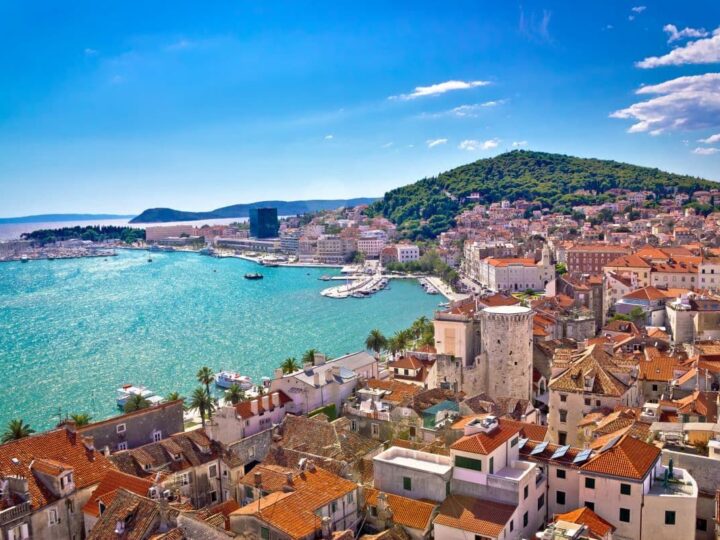
If photography is your thing and you’re looking for a favorable observation point, then grab your camera and hike the 314 steps that take you up Marjan Hill.
You will not only be rewarded with spectacular views of Split and the coast, but you will also discover the ancient Jewish cemetery in town.
Marjan Hill stands about 600 meters above the town and is a green oasis.
From here, you can enjoy views of the city or simply enjoy some outdoor experiences, including hiking, bird watching, and rock climbing.
The Coast
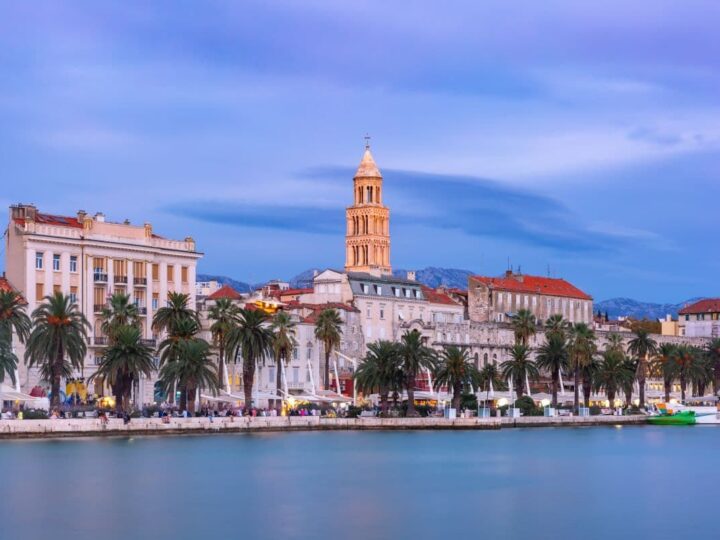
The seaside area of Split is a perfect place for a relaxing walk at sunset, to sample delicious Croatian foods and wines, or to simply pick one of the many restaurants, bars, or beach clubs in the area and sit facing the sea.
Many of them serve delicious dishes and enticing cocktails in a quaint atmosphere.
Many of the beach bars attract locals and tourists alike, and picking one of them for dinner is a great idea, even for solo travelers who might feel overwhelmed in more traditional restaurants.
In general, the whole coast has a relaxed vibe, making it rather easy to strike up a conversation and have fun, even if you visit on your own.
Bacvice Beach
Visiting during the summer months? Then head to the central area of the coast in Split to spend an afternoon swimming or sunbathing at Bacvice Beach.
The sandy shore is very popular, but its shallow waters make it safe and an interesting spot for snorkeling or scuba diving.
Along the seaside promenade, you will find everything you need for a day at the beach, from water sports facilities to restaurants and snack bars serving quick sandwiches, delicious appetizers, and tempting summer cocktails.
The Public Market
There is nothing like a visit to the outdoor market in Split to get a taste of its delicious cuisine.
This particular Croatian market is a favorite among locals who visit early in the morning to buy seafood, vegetables, food, cheese, and meat.
Tourists, instead, enjoy wandering the market to check out local fashion. There are clothes, shoes, and handbags on offer too.
Souvenirs from Split, including local drinks and cheeses, can also be purchased.
Best Day Trips from Split
The city’s central location in Croatia makes it a great starting point for day trips. For instance, you can explore the nearby coast or venture north to discover the most beautiful lakes in the country.
Hvar Island
Hvar Island is located off the coast of Split and is an interesting day trip destination.
Ferries leave from the port of Split, but several organized tours include lunch, wine tasting, and a guided visit of the island.
This tour in particular also offers a stop on Pakleni Island before reaching Hvar.

Plitvice Lakes
Croatia’s most famous landmark, Plitvice Lakes, is located about three hours north of Split.
Probably the most visited place in the country, this is a beautiful day trip that takes you to discover the dozens of waterfalls and the magnificent clear lakes that make Plitvice a protected national park and a wonderful, year-round destination.
It is possible to get there by bus or by car, although an organized tour is recommended to visit as many points of interest in a day as you can.

Vis Island
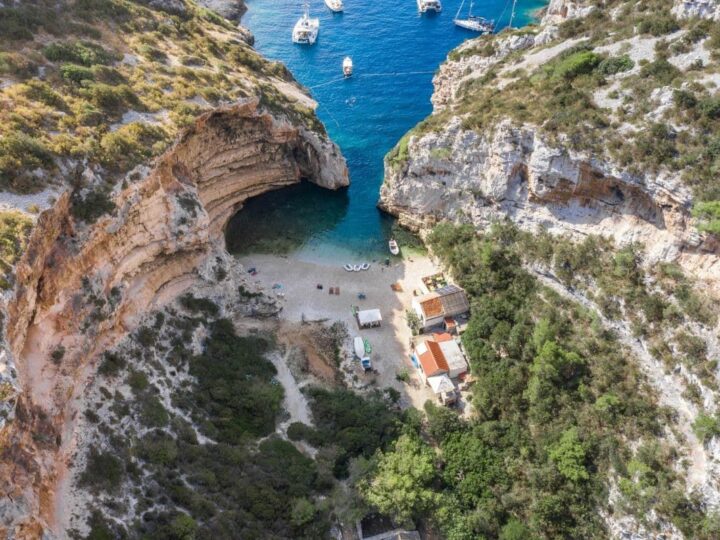
Finally, a day trip to Vis Island allows you to visit some of Croatia’s most famous blue caves.
Surrounded by crystal-clear waters and a wonderful coast, Vis can be perfect for a relaxing getaway.
Besides, on the island, you can visit important Croatian wineries, discover not one but two picturesque old towns, and enjoy a memorable seafood lunch.
You can take the ferry at the port of Split and then hire a scooter on the island to explore it, or you can join an organized tour with everything included to visit Vis and other islands off the coast of Split.
Final Thoughts
It’s not difficult to see how this ravishing town can conquer travelers, no matter what time of the year you visit.
Home to a rich past as well as some of the most beautiful beaches in Croatia, spectacular nearby islands, and an enchanting old town, it’s easy to understand that there is a little something for everyone in Split.
Perfect when seen on its own or as one more stop in a longer multi-day itinerary of Croatia, Split will conquer you with its Venetian flair and its aristocratic Roman atmosphere.
Save this to Pinterest for later!
More Places to See in Europe
When is the Best Time to Visit Italy?
How to Day Spend 7 Days in Greece
Cinque Terre Italy Travel Guide
Which Islands to Visit in Greece?
About the Author

Gabi Ancarola is a translator and travel journalist living in Crete. She regularly writes about Europe for several magazines about travel, gastronomy, and hospitality. She has published several travel guides about Greece and plans customized trips to the Greek islands. She loves cooking local dishes, taking photos, and driving on the mountain roads of Crete.