
There’s no better destination in Italy than the capital of the country, Rome. Despite its chaotic vibe, the city is one of the best places for a real taste of the Bel Paese as well as to indulge in the magnificent monuments that have reached our days from the ancient Imperial Capital.
Boasting a myriad of things to see as well as a fantastic gastronomic scenario, the city is an ideal place to visit in Europe, and three days in Rome will offer plenty of things to do and activities to enjoy.
This post may contain affiliate links and Solo Trips and Tips may receive a commission for purchases made through links. See our disclosure about affiliate links
Explore This Guide:
Day One: Vatican City and Historical Gems
Vatican City
Since it is the most visited place in town as well as one of the most popular European destinations, head here early to beat the crowds and devote at least a whole morning to the Vatican City and some of its museums.
You can purchase a skip-the-line ticket for better organization and to make the most of your day.
Among the places to visit during this day, start with the imposing Piazza del Popolo, right in front of Saint Peter’s Basilica, the seat of the Pope and the most important church in the world.
Inside the church, you will be able to admire some of the most important art masterpieces in the country, including Michelangelo’s La Pietà, or “The Pity” (from 1499), a terrific example of Renaissance sculpture.
The Sistine Chapel and the Vatican Museum are two more gems not to miss.
With its magnificent interiors, the chapel marvels visitors with Michelangelo’s iconic Creation of Adam.
If you’re interested in more religious tourism, you can devote a few hours of your day to exploring Castel Sant’Angelo, just a few minutes from the Vatican’s main square.
To get there, it’s a good idea to walk along Via della Conciliazione and discover unique shops selling religious art as well as more unique stores, like the one making and selling papal robes or the iconic red papal shoes.
Castel Sant’Angelo is a distinctive fortified structure of imposing height that not only offers incredible views of Rome but also interesting collections in its museum.
Sheltering centuries-old secrets, legends, and mysteries from different Popes, the walls of this former historic mausoleum and monumental tomb were originally constructed in the Middle Ages. It was also used as a fortress and served as a papal residence.
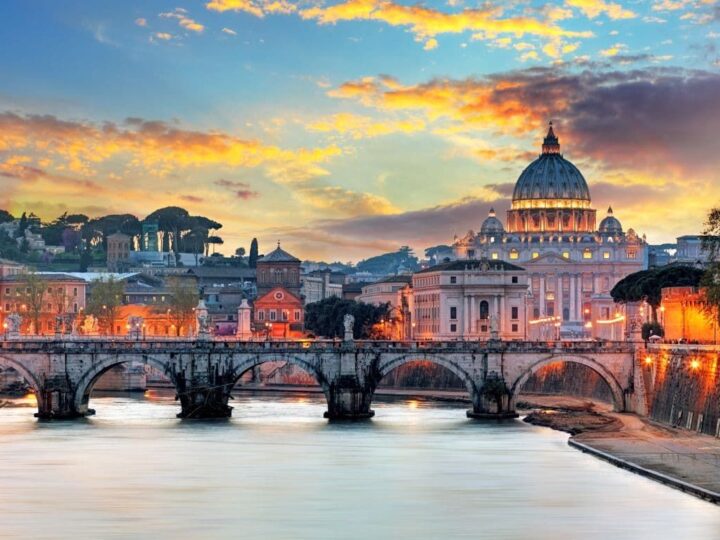
From the roof terrace of the castle, you can spot some of the most gorgeous sights in town, including the Tiber River and the charming Bridge of the Angels.
You can stop for a quick panino, a slice of pizza, or just a refreshing soft drink in one of the many small trattorias that you will find surrounding the Vatican area.
There’s no need to waste precious time with a full lunch when a snack on the go will easily give you the right amount of energy you need to keep exploring.
Historic District
Cross the Bridge of the Angels in order to do some on-foot exploration of the iconic alleys in Rome’s historical district. This way, it will be easy to bump into places that you want to see when in Rome.
These include Piazza Navona with its imposing Fountain of the Rivers, the Pantheon with its incredible dome, and the world-famous Fontana di Trevi.
The three spots are within walking distance of each other and easy to visit in a bit more than an hour without needing to join an organized tour to see them.
An original way to spend the last hours of the afternoon is to explore some other iconic landmarks that, at dusk, get a completely different vibe with the last light of the day.
Walk from the Trevi Fountain (Fontana di Trevi) towards the area of Piazza di Spagna (the Spanish Stairs) to admire Bernini’s Barcaccia Fountain and the Trinità dei Monti Church.
Located at the top of the steps, the golden hour is at its best in this spot of Rome.
The area is full of small restaurants and cafeterias, making it the perfect place to end your day with a traditional Roman dish, for instance, spaghetti alla carbonara or a succulent dish of bucatini all’amatriciana, two of the most delicious staples of the Lazio region’s cuisine.
Pair them with a glass of top quality Italian red wine, and you’ll be ready to call it a day!
LEARN MORE: 35 Famous Landmarks in Italy

Day Two: Classic Rome
Colosseum
Again, an early wakeup call so as to make the most of your morning while also beating the crowds. Book an early skip-the-line ticket to the Colosseum, a place popular especially among small kids due to the countless stories and legends of gladiators and emperors that surround the structure.
Keep in mind that families with kids are less likely to visit the Colosseum very early in the morning, so it’s always a good idea to choose an early time slot to access the famous Roman arena.
If you do not have a solid knowledge of the local history, joining a tour with an official guide can prove extremely rewarding, helping you make sense of the countless ruins and ancient archaeological sites that you will encounter today.
Along the way, you will be able to learn about famous legends of ancient Rome, including the details about the construction of the Colosseum, the largest amphitheater ever erected and dating all the way back to the year 80 CE!

Palatine Hill and Roman Forum
The sites of the neighboring Palatine Hill and Roman Forum put you in front of an impressive cluster of monuments that highlight details about the foundation of the Eternal City.
From the Palatine Hill, it’s possible to admire a vast collection of ancient columns, archways, and temples down below.

Authentic Roman Lunch
A visit to these ancient sites will have probably consumed most of your second morning in Rome, making it time to stop for lunch.
Don’t worry though; today we won’t be having just a quick snack. On the contrary, let’s indulge in an authentic Roman meal in one of the places that locals seem to prefer.
Located just a few steps from the Colosseum, Il Bocconcino is a rustic osteria specializing in old Roman recipes made with seasonal ingredients and free-range meats.
The place serves some of the most traditional old Roman dishes that feature vegetables and ingredients often forgotten in Rome’s more modern cuisine.
Some of the recipes come from the ancient Jewish-Roman tradition, as the restaurant is in the heart of the former Roman ghetto area, a community with roots dating back to the second century BCE.
The place is a favorite among locals, so booking at least a day before is not a bad idea. Don’t miss it!
Catacombs Crypts and Aqueducts
If you’re looking to spend a different afternoon in Rome, then why not venturing into the ancient catacombs, crypts, and aqueducts that made the Eternal City famous all over the world?
This can be a thrilling experience, no matter your age and interests, and offer a completely different perspective on Rome.
Although it is possible to do the visit on your own, an organized tour experience sounds more safe and ideal to get all the necessary information about the history of these places.
Moreover, you’ll avoid navigating from one site to another via public transport and therefore waste less time.
This challenging experience has you venturing into some of the most secret parts of the city, places that often go unobserved by regular visitors.
Start by exploring the labyrinthine Roman Catacombs as well as the spectacular Capuchin Crypt, known as the Cappella delle Ossa, featuring ages-old walls decorated with the bones of thousands of monks.
Keep in mind that there are over 15 different catacomb sites in Rome or just outside of Rome, including the Jewish catacombs. A bit of extra planning might be necessary if you insist on doing this visit on your own.
Another incredible sight to add to this experience are the Roman Aqueducts, a monumental landmark of the spectacular power of the Roman Empire.
If you’re visiting on your own, keep in mind that, for instance, Aqua Claudia Aqueducts are just outside Rome, and you can get there with metro line A (Giulio Agricola station).
You can also visit the Catacombs of Domitilla; to get there, jump on bus 218, and the ride from Porta San Giovanni station is about 15 minutes.

Best Pizza in Rome
I’ve named this second day in Rome, Classic Rome. And is there a more classic or better way to end your day than with some delicious pizza?
There is quite a controversy when it comes to deciding which place serves the best pizza in Rome. And making up your mind is not easy.
For that reason, I propose the three best-rated pizza places in Rome for you to decide which one to visit.
Piccolo Bucco
One of the best pizza restaurants in Rome, Piccolo Bucco (translating as little hole), is known both for its location, only steps from Trevi’s Fountain, as well as for the delicious Naples-style incredible crust paired with Roman toppings.
Piccolo Bucco is at 91 Lavatore Street.
Trapizzino
If you’re eager to enjoy a quick bite or some pizza al trancio (kind of a slice on the go) style of pizza, Trapizzino features slowly leavened pizza dough with quite odd Roman toppings, including original meat cuts.
Trapizzino is at 88 Giovanni Branca Street.
Pinsere
You cannot leave Rome without a taste of the local oblong pizza, known as pinsa. For a taste of this delicacy, head to Pinsere, a pizza joint specializing in light crust and mouthwatering toppings. Another on-the-go alternative for excellent pizza in Rome.
You will find this venue at 98 Flavia Street.
Before you go to Rome, it’s a good idea to read Solo Trips and Tips guide on the Do’s and Don’ts of Dining in Italy.
Day Three: Local Food & Trastevere
It is a good idea to devote the third day to discovering some unique local gems that most tourists would overlook or simply walk past without even noticing them, simply because they are often overlooked in most city guidebooks.
Food Tour with Sightseeing Guided Tour
A fantastic way to enjoy such an experience is to visit the town on foot and with a local guide who really knows the secrets of Rome. If such a tour also includes some bites and even a wine tasting experience, like this Rome food tour, even better!
Such an experience will walk you through the least-known secrets of Rome but will also allow you to sample incredible delicacies that you would otherwise miss, such as original cheeses and cold cuts that locals enjoy all year round.
Cooking Class in Rome
A good alternative for those with sore feet after two days walking around Rome’s historical center, is to join a gastronomic class and learn to make tiramisu, gelato, or even pasta. Because really, what better souvenir of Rome than a bunch of original recipes to recreate at home?
Joining such an experience is perfect for spending a morning and skipping lunch to head directly to your last stop in Rome: Trastevere.

Trastevere Neighborhood
Known as the bohemian corner of the city, Trastevere is a charming district in the lesser-visited area of town, on the opposite side of River Tiber (Trastevere literally means beyond the Tiber), not far from the Vatican.
A simple walk along the maze of cobblestoned alleys in this neighborhood can be romantic enough to make you promise yourself that this won’t be the last time you pay a visit to Rome.
The old working-class neighborhood has transformed into an enchanting hangout, where ancient medieval dwellings mix with restaurants, trattorias, gelato and pizza places, and some of the most gorgeous cafés in town.
However, Trastevere offers more than that for those who want to really experience it; the area also hosts incredible ancient villas that once belonged to prominent Roman inhabitants, including the most famous Roman emperor of all time, Julius Caesar.
If you happen to be in Trastevere on a Sunday, then don’t overlook the opportunity to wander around the stands of one of Rome’s most famous flea markets, Porta Portese, a public market so famous that there’s even a popular song that honors this lively street market.
When in the area, check out the impressive Basilica of Santa Maria in Trastevere, the oldest Marian church in the city.
Check out the different monuments and statues around the district, and spend some time chilling in Piazza di Santa Maria in Trastevere, just opposite the church, one of the most popular meeting places in the neighborhood.
Wondering how to end the day? Pick a traditional osteria like Tonnarello (Della Paglia Street) and sample one of the best meatballs you’ll ever find in Rome!
Planning a 3-Day Trip to Rome
Where is Rome and How to Get There
Located on the Tirrenian coast, right in the geographical center of Italy, Rome can be easily reached from any point in the country by means of a relatively short train ride.
There are several train stations in town, with Roma Termini and Roma Tiburtina the most important ones, also featuring connections to the city airports.
The city also receives visitors via long-distance buses, while its two international airports see visitors coming from the rest of Europe as well as from the US, Canada, Australia, and the Middle East.
In fact, you can fly to Rome from virtually any country in the world.
READ MORE: When is the Best Time to Visit Italy
Moving around in Rome
The city has a solid public transport network with buses and different metro lines.
The metro, however, can feel somewhat limited due to the endless archaeological excavations around the city.
Although the buses can take you anywhere in town, sometimes the metro offers faster connections as the traffic in the city tends to be quite intense during most of the day.
The city also has a few tram lines, which can be an original way to move around too.
Rome also offers urban railways for short trips out of town. The urban railway is a good and affordable way to visit nearby villages and the coastal area of Ostia Antica.
LEARN MORE: What to Do in One Day in Rome
Rome Public Transit Tickets
When moving around in Rome, it’s a good idea to buy the transport ticket or travel card that would best adapt to the quantity of sightseeing you want to do and the length of your stay.
Among the different tickets, consider the following options:
BIT (one way ticket): This ticket has a 75-minute validity since the first obliteration (obliterating machine on the bus and tram or at the metro station and urban train station). The ticket allows for unlimited transfers within 75 minutes of the first validation (price: €1.50).
MetroBus 24/48/72 hours: With this ticket, you can have unlimited access to public transport from the first validation until midnight (the 24-hour pass), for 48 hours (the 48-hour pass), or for 72 hours since the first validation (the 72-hour pass).
Prices are €7 for 24 hours, €12.50 for 48 hours, and €18 for 72 hours.
If you plan to spend the three days in the city and even want to visit the coast, then the 72-hour pass is the one we suggest you purchase.
There are also weekly travel passes, good for longer stays; the price is €24, and it allows you to use unlimited public transport for 7 days.
All travel cards and tickets can be obtained at automatic vending machines, newsstands, and other convenient stores.
LEARN MORE: What to Eat in Rome (Best Foods to Try)
Prepaid Entry Tickets in Rome
When visiting such a popular destination, planning ahead is key to a successful and stress-free experience.
It will be the best choice you can make, and it will help you navigate the city easily, avoiding long lines and maximizing your time in town.
Although organized tours take some freedom away as you need to be aware of starting times and schedules, some of them will provide a magnificent way to visit more than one point of interest in a relatively shorter timeframe, something you will appreciate if you’re interested in seeing several landmarks in a day.
If organized tours are not your cup of tea, though, do not disregard skip-the-line passes and entrance tickets purchased before the trip.
They will ensure visiting super popular spots such as the Vatican Museums or the Colosseum without a long wait. This tip is especially useful in the summer, when long waiting lines under the sun are everything but a comfortable experience!
Some of these passes offer great value for money and enjoy top reviews from travelers around the world. Following are the ones I eagerly recommend you consider before your departure.
Skip the Line and Food Tours in Rome
Vatican Museums & Sistine Chapel Skip-the-Line Tour: This is a great pack if you plan to visit the Vatican. This is a value-for-money pass that lets you discover the wonders of the art collection inside the Vatican Museums on a tour with an art historian guide and skip-the-line entry tickets. Buy Vatican Museums/Sistine Chapel pass now!
Colosseum, Roman Forum, Palatine Hill Entry Tickets: This is another skip-the-line collection of tickets to visit different Ancient Rome landmarks located in the same area of the city.
You are allotted a visiting time in order to be able to skip the lines and head directly to the monuments through a dedicated fast-track entrance. A downloadable map of the sites is included with the tickets too. Buy the ticket now.
Street Food Tour with Local Guide: Although there is no skip the line vantage in this tour, I always suggest travelers enjoy local food and street food hosted by a local. And the earlier during your trip you do this tour, the better.
Oftentimes, the guide won’t only take you to the best places for bites and food that Romans love to enjoy and are not known to tourists, but they will also suggest the best places for pasta, pizza, coffee, and gelato along the way.
The earlier you take such a tour during your visit, the more places you’ll be able to visit again when not certain where to eat in Rome. These tours are often fun, affordable, and a great way to meet people when traveling solo.
LEARN MORE: 10 of the Best Free Things to Do in Rome
Where to Stay in Rome
Once the basics of the trip are more or less settled, let’s check out the best areas in town in order to experience the most beautiful spots in Rome.
When picking the area where to spend your nights in Rome, you should consider public transport, safety, and access to sites, as well as shops and convenience stores, restaurants, and nightlife in general.
Keeping all those details in mind, it’s safe to say the historical district of Rome, known as Centro Storico, is a great place to stay.
It’s often busy and packed with typical sights, including spectacular fountains, monuments, and statues, but also bars, restaurants, and shops.
Central Rome
UNAWAY Hotel Empire Roma is a beautiful building located in the center of Rome, steps from the fantastic Via Veneto. Recently renovated and equipped with modern amenities, the hotel rooms are modern and functional, with elegant touches and welcoming spaces.
There is also a picturesque piano bar, an excellent restaurant, and a fitness center. Check availability and book your stay now
Trastevere District
It’s also true that not all travelers are created equal. And not everyone enjoys the hustle of the most popular districts in town. In that case, a small studio or a boutique hotel in the Trastevere District can be a good compromise.
It offers excellent dining experiences, romantic Roman views, and everything surrounded by a calm atmosphere and a more laid-back vibe while remaining well-connected to the more vibrant neighborhoods in Rome.
Trastevere Suites Collection is a winning accommodation option in the area. This guest house features a beautiful garden, very comfortable rooms, and easy access (either walking or via public transport) to local landmarks such as the Roman Forum, Palazzo Venezia, Piazza Navona, and Campo de’ Fiori.
Read reviews and book a room at Trastevere Suites Collection now.
Roma Monti Neighborhood
If you can spend a bit more on accommodation, then Roma Monti is a good alternative. The area is close to important monuments that you will want to explore during your stay, such as the Colosseum. And there are good shopping areas, a residential atmosphere, and a good selection of venues for nightlife and entertainment.
HS 311 is a hotel offering accommodation only meters from Piazza Venezia and the Roman Forum.
Here, the rooms come with convenient comforts, including a coffee machine and kettle, perfect to savor your first morning fix without even leaving the room.
Make a reservation at HS 311 for a great location while visiting Rome.
Final Thoughts
So, there you go: three full days in Rome packed with interesting cultural activities, tons of amazing sightseeing, and some of the most delicious tastes in town. Don’t tell me that you are not eager to start packing right away!
Save this to Pinterest for later!
More Places to See in Italy
20 Things to Do in Cinque Terre
Guide to Florence (including Where to Stay)
Best Things to Do in Amalfi Coast
Guide to Venice (including Where to Stay)
About the Author

Gabi Ancarola is a translator and travel journalist living in Crete. She regularly writes about Europe for several magazines about travel, gastronomy, and hospitality. She has published several travel guides about Greece and plans customized trips to the Greek islands. She loves cooking local dishes, taking photos, and driving on the mountain roads of Crete.