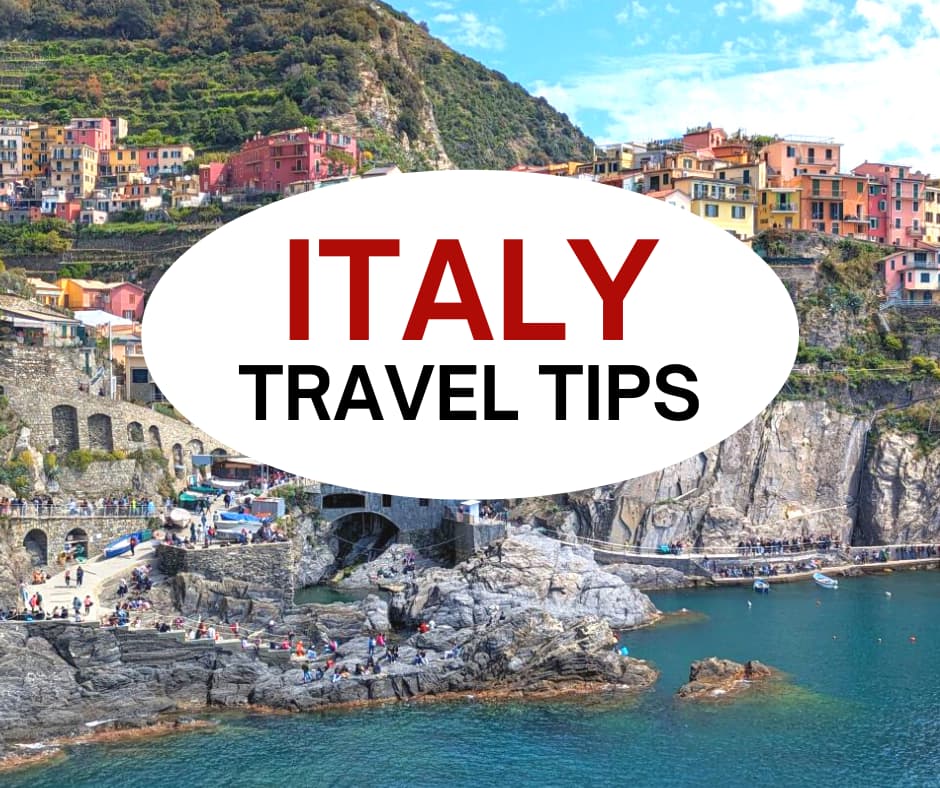
There were a few things that surprised me during my first solo trip to Italy. For instance, train strikes are common in Italy. Also, the Italian way to have morning coffee is not a leisurely affair. In this article, I’m sharing 40 Italy travel tips so that you can make the most of your experience and have an idea about what to expect while traveling to Italy.
I visited Italy from mid-April to mid-May. And I stayed in Bologna, Cinque Terre, Florence, Milan, Rome, and Venice during my month of travel. Originally, I planned to also visit Naples, Amalfi Coast, and Sicily, but decided to save that for another trip focusing on Southern Italy.
Here are my tips for visiting Italy…

Explore This Guide:
Planning Your Days in Italy
1. Slow Down
Slow down and embrace a more relaxed pace when doing things in Italy, because that is the Italian way. You may expect tours and events and everything to run exactly on schedule, but I suggest you set that thought aside and instead get used to the idea that everything may be a little late, not on a strict schedule.
2. Plan on Walking a Lot
You should plan on walking a lot because much of Italy is best explored on foot. Wear comfortable walking shoes especially when walking on uneven surfaces like cobblestone.
3. Avoid Peak Season
The peak season for travel in Italy is June and July. While August is when Italians take vacations to the coastal areas, you can expect expensive prices and crowds at the beach towns. Summer is also hot and humid in most of Italy including popular tourist locations like Rome, Venice, Amalfi Coast, Sicily, and Florence. Avoid the summer season if at all possible and instead visit during spring or fall.
Easter and Christmas are also peak travel times in Italy so try avoid traveling during the major holidays.
4. Travel During Shoulder Season
Shoulder season is a great time to visit Italy. Why? Shoulder season is just before and just after peak season, so hotel prices are usually cheaper, but the weather is often pleasant.
Shoulder season in Italy is typically in the spring, from March or April through May, and in the fall, from September through October and even into November. Read our article on the best time to visit Italy for more information on the seasons and options for your trip.
5. Know the Italian Holiday Dates
While Christmas and Easter come to mind for busy holiday travel, there are other important holidays to consider when booking your holiday to Italy. Some holidays are regional, so check with the local travel sites for each region to find out more.
Here are a few of the big holidays in Italy:
Besides Christmas Day, there is also a holiday on December 26 to celebrate St Stephen’s Day in Italy.
New Year’s Day is followed by the Epiphany holiday on January 6th.
Easter Sunday and Easter Monday are celebrated in Italy, so check the dates if you are traveling in April or May. Note that Good Friday is not a holiday in Italy.
April 25 is Liberation Day, and especially when it falls near a weekend, you can expect a lot of Italians will be traveling, so plan your travel and accommodation carefully. During my month in Italy, I happened to be in Cinque Terre for Liberation Day in 2023, and it was massively crowded but still fun!
May 1 is Labor Day (known in Italy as La Festa dei Lavoratori, also Primo Maggio), which is also a holiday to keep in mind when planning your travels. In Rome, there is a huge music event called “Concerto a San Giovanni.”
6. Don’t Overschedule
At first glance, it may seem easy to visit all of Italy in a couple of weeks. Don’t plan on it. Instead, if you have two weeks in Italy, I suggest you focus on one region, for instance, either the North or the South; don’t try to do both.
Especially for your first visit to Italy, make sure you have enough time to enjoy each place you visit. Generally, plan on spending at least three nights in any major city. You can also add a few more days to factor in day trips to smaller towns and villages, for example, day trips from Rome or day trips from Florence.
And don’t overschedule your days with activities and tours at close intervals. Instead, leave some time in your days for relaxing walks, long meals, and chatting with locals when the opportunity presents itself.
7. Expect Crowds
Expect tons of tourists, obviously, but expect twice as many as you imagined! And even though you may see photos of famous places without a lot of people around, such as Trevi Fountain, don’t count on it. You’re best chance of having fewer people around is to get up early in the morning, at first light.
Train Travel in Italy
An easy and affordable way to get around Italy is to travel by train. Many routes include high-speed trains so it’s a lot faster than driving.
I recommend you bookmark Italy’s train travel website Trenitalia and download their app so you have easy access to train tickets, info, self check-in, and more. You can also use Italiarail which is an official partner of Trenitalia.
8. Find Cheaper Train Tickets in Italy
Book tickets early (1-2 months or more) for cheaper ticket prices on high-speed trains. Last minute tickets cost more.
I booked all my train tickets over a month in advance of my flight to Italy. Note that there are various options and prices for the class of ticket and whether or not you make changes to your ticket after purchase.
9. Train Strikes Common in Italy
One important thing about train travel in Italy that you need to be aware of is that train strikes and public transport strikes are common in Italy. But they announce them in advance, so check the website for Commissione Garanzia Sciopero (I can’t get it to load in USA but I can confirm the link works in Europe during my 2026 trip.) for train strike announcements. An alternate site is Ministry of Infrastructure and Transport in case you can’t access the other website.
Strikes often occur on Fridays (I wonder why, eh?) but they can occur on any day of the week. I did notice there was a train strike on the Friday following Easter Sunday in both 2022 and 2023. Maybe this is a new Easter tradition in Italy?
Also, train strikes often begin at 9:00 am and finish at 6:00 pm so if you purchase your ticket for an early morning departure, that may help you avoid the hassle of a strike.
The important thing is to have a backup plan if the trains do go on strike. And be proactive by checking for train strikes so you can make alternate plans as soon as possible.
10. Wi-Fi on Trains
Don’t expect the Wi-Fi to work on the trains. If it does, you are lucky. If you need Wi-Fi you should have a backup plan such as a Wi-Fi hotspot for travel.
11. Validate Train and Waterbus Tickets
Remember to validate your travel tickets when necessary, for instance, when you use the waterbus in Venice, for bus tickets, or train tickets.
Often, when you buy online, you don’t need to validate the ticket, but check to make sure you don’t run afoul of the rules in Italy. Importantly, if you don’t validate your ticket, you may have to pay again, along with a hefty fine.

Hotels in Italy
In the major cities you’ll find hotels ranging from budget to luxury accommodation. While in smaller towns, such as the Cinque Terre coastal towns, you will find more boutique hotels. For the best selection and prices book your accommodation early, as soon as you know your travel dates. Note that hotel prices will double or triple during peak season.
12. Budget Lodging at Monasteries
Something I wish I had known before I booked my trip to Italy is the fact that certain monasteries in Italy offer lodgings for reasonable rates. And you don’t have to be religious or single to do this. Check out the Monastery Stays website. Read the FAQ and cancellation info to make sure you know what to expect. As with most hotel reservations, the earlier you book, the better options you’ll have available.
13. Italy City Tax for Hotels
Hotel city tax is charged for the first 5 nights in Venice, but elsewhere, it seems they charge the city tax for every night of the reservation.
The hotel tax rate also varies by hotel quality and the season. Some places only accept cash for the hotel city tax.
14. Tipping at Hotels in Italy
It isn’t customary or expected to leave a tip for housekeeping at hotels in Italy. But if you want to you can leave a euro per night for housekeeping, and a euro per bag for the porter. Nobody will be offended if you don’t tip, but they will appreciate it if you do tip.
15. Air-Conditioning in Italy
Don’t expect air conditioning in your hotel room except when it’s very hot outside and if it’s within the season that Italians consider air-conditioning worthy.
Even if the hotel boasts of having A/C, they won’t necessarily turn on the air conditioning until they decide it’s hot enough to warrant the use of AC. For instance, on my first night in Rome in early May, there was no A/C, even though it was a sunny and very warm day. Thankfully, the next evening the air-conditioning was turned on.
16. Beds in Italian Hotels
Don’t be surprised if your queen-size bed is actually two single beds pushed together to make it queen-size. It can be a bit uncomfortable to sleep in the middle of the bed when this is the case, so just pick a side before you slumber.
If you are traveling solo to Italy, you’ll find some hotels have single rooms with just a single bed. These rooms are more affordable than a double room, so it’s a good way to save on accommodations.
17. Bathrooms in Italian Hotels
Expect tiny showers; like seriously, I got used to bumping my elbows on the sides of the showers because they’re so small.
Also, expect a bidet in your hotel bathroom. Personally, I wish this were the norm everywhere in the world.

Dining in Italy
Food in Italy is regional, for instance ragu and lasagna originate from Bologna while Rome is well known for pasta alla carbonara. Learn more about the foods of Italy by region.
Do try different foods and remember that it’s usually best to order foods that are local to the region you are visiting.
Also, at restaurants always wait to be seated. Even at outdoor cafes, don’t sit at a table until you have talked with the staff first to confirm.
Read more about do’s and don’ts of dining in Italy.
18. Restaurant Service Charges
Expect to see a charge on your bill for sitting in the restaurant, using up space, plus the extras such as bread, oil, vinegar, salt and pepper, etc.
On your receipt, it is listed as “coperto” or “servizio” and usually is anywhere from 1.50 euros up to about 3 euros, but it can be even more in trendy restaurants.

19. Tipping at Restaurants in Italy
Tipping at restaurants is not required or expected in Italy, but it is appreciated. If you’ve enjoyed great service you can round up your bill a few euros to show your appreciation.
20. Coffee in Italy
Espresso is the most popular style of coffee for Italians. But you can also get other styles of coffee, and often even a big cup of Americano too. If you prefer latte you’ll want to order latte macchiato in Italy.
Although Italians enjoy taking their time when dining out, that is not the case with morning espresso. They will drink it quickly while standing at the counter of the café.
Another thing to know about coffee in Italy is that Italians don’t drink cappuccino after lunch. You can order cappuccino at breakfast or early in the morning, but by noon, espresso is the norm.
However, during my travels, when I noticed tourists ordering cappuccino after lunch, there was no argument or even the slightest look of disgust from the servers.
So, if you simply love to drink cappuccino after lunch, you can be a rebel in Italy and order a cappuccino in the afternoon. Personally, I prefer a macchiato, which is an espresso with a little milk. Give it a try and see if you agree it is the best coffee!
21. Breakfast in Italy
Don’t expect to find big American style breakfasts at restaurants. Most cafes have only coffee and pastries on the breakfast menu. Bakeries are a great option for a variety of pastries and sometimes pizza by the slice, available even in the mornings.
Alternatively, hotels often provide buffet-style breakfast (usually for a fee but sometimes included in the price of the room). The buffets typically include all sorts of pastries, salami, prosciutto, hard-boiled eggs, fruits, yogurt, toast, coffee, juices, and plenty more.
22. Aperitivo Hour
In Italy the aperitivo hour usually starts around 6:30 or 7:00 pm and consists of a drink and small bites about an hour or so before dinner. It can be at the same place you will eat dinner or elsewhere, such as a piazza or small bar.
Popular drinks served for aperitivo hour include cocktail-style drinks such as Negroni, Campari, Bellini, and Aperol Spritz. Note that Campari and Negroni have a much higher alcohol content than Aperol or Bellini. Of course, you can also enjoy a non-alcohol drink for aperitivo hour such as juice or the Italian drink Crodino.
23. Bread in Italy
Typically, every restaurant will serve a small basket of bread before your meal. Especially in northern Italy, it is served with olive oil, balsamic vinegar, and salt, and it’s usually very good.
In Florence (and all around Tuscany), the bread typically does not include salt in the recipe. If you’re thinking, “That doesn’t sound yummy,” you are correct.
Apparently, saltless bread is due to an exorbitant tax on salt back in the Middle Ages. The Tuscans decided to make their bread without salt rather than paying the tax, and the habit continues even though salt is now so cheap and readily available.
24. Where are the Vegetables?
When dining in restaurants in Italy, I was surprised at the lack of vegetables served with meals. You really need to make an effort to get some veggies on your plate.
Even when I ordered a pasta dish with eggplant, the serving was light on eggplant. Sure, you can order a salad, but I often found the salads were rather disappointing, with just lettuce, tomato, and cucumber.
At La Lampada restaurant near my hotel in Rome, I did find a fabulous all-vegetable dish that was very satisfying.

25. They Aren’t Ignoring You
Don’t expect your server to check up on you after bringing your food. It’s up to you to get their attention if you want something more. Except in the busiest eateries in the most touristy places, you can sit for hours in the cafes and restaurants.
I talked with some American tourists who complained about the “rude service,” but I loved being left alone to enjoy my meal without constant interruptions or feeling like they wanted me to hurry up and leave.
26. Expect to Wait for Your Check
Don’t expect your bill immediately after you finish eating; you will wait, and wait, and wait to get the check. In fact, you may find it somewhat difficult to receive your bill.
When I did find it impossible to get anyone’s attention, I walked to the cashier station within the restaurant, and they prepared my bill and took my payment.
27. Ask for a Take-Away Box
It’s okay to ask for a box for leftovers from your meal. The pasta (first course or “primi piatti” in Italian) was often enough for me for a meal on its own. But I like to try other dishes too, so I asked for a take-away box for the leftover food. In most hotel rooms that I stayed in, there was a mini fridge, so storing leftovers was no problem.
28. Shop the Neighborhood Food Markets
Italy is well known for its gastronomy and for growing some of the best fruits and vegetables around, so you should try a variety of the local foods. Shop at the neighborhood fruit and veggie markets to get the freshest produce.
And do try the fresh tomatoes! They’re actually flavorful and delicious, not at all like the tomatoes we get these days in the US or Canada, which simply lack flavor.
I enjoyed eating the delicious fresh fruits in Italy. The Sicilian strawberries are absolutely scrumptious and full of flavor. There are several types of oranges and lemons grown in Italy too, so do try some of the locally grown fruits.

29. Dining Solo in Italy
I didn’t experience any problems getting seated at a table for one in Italy during my travels. Although sometimes I did get the “only one?!” response when I said I was dining alone, overall, dining solo in Italy was enjoyable.
Truthfully, most of the dining tables at the outdoor cafes in Italy are set so close together that you are always dining with others LOL! Seriously, the small tables at the trattorias are sometimes only a few inches apart.
Travel Safety in Italy
Generally speaking, Italy is considered a safe travel location, even for solo female travelers, but that doesn’t mean you can be careless. So always be aware of your surroundings, keep your handbag close to your body, and trust your gut instinct.
30. Pickpockets and Petty Theft
Always keep your handbag in sight. When dining out, don’t leave your purse under your table or hanging over the back of the chair. Trust me, you may have your wallet or credit card stolen. Ask me how I know :/
Consider using a money belt or an anti-theft cross-body travel bag to protect your valuables. I always bring two credit cards and two debit cards and keep them in separate places in case one gets lost or stolen.
31. Keep a List of Important Numbers
Keep a list both on your phone and on paper of the most important numbers you may need, including the emergency number in Italy which is 112 (equivalent to 911 for fire, police, ambulance). There is also an emergency medical service number which is 118.
More Tips for Traveling in Italy
32. Download Google Maps Offline Maps
I always download Google offline maps when I travel so that I can navigate even if I don’t have internet or cellphone service. Note that directions for walking/cycling/transit won’t work offline, but the map will still show your location (with a blue dot) and you can navigate on your own.
33. Have Some Euros for Bathrooms
Some public bathrooms and pretty much all train station bathrooms charge one euro to use the facilities. Sometimes they take credit cards, but most only accept coins, so always carry at least a euro or two with you for the bathroom.
34. Book Tickets Early for Popular Attractions
For some of the most popular attractions, you have to book tickets early, perhaps a week or more in advance. For instance, in Rome for the Vatican, Colosseum, or crypt tours, and in Florence for the Duomo, Uffizi Gallery, and Accademia Gallery.
Pro Tip: If everything is totally booked, keep checking the attraction and tour websites every morning because they often have cancellations, so you may get a last-minute entry ticket.
35. Learn a Few Basic Italian Words
At the hotels in major cities, you can expect the staff to be fluent in English and also at many restaurants. But it’s best to learn a few key words and phrases in Italian.
- Hello – ciao
- Goodbye – ciao
- Please – per favore
- Thank you – grazie
- Excuse me – mi scusi
- I don’t speak Italian – no parlo Italiano
- Do you speak English? – lei parla inglese
You can practice with apps like Google Translate so you can read and hear the pronunciation and repeat the words. Duolingo is a pretty good language app, and you can use it for free. Read more about overcoming language barriers while traveling.
36. What to Wear in Italy
Europeans don’t usually dress as casually as Americans. And, certainly when visiting churches you should dress conservatively; cover your shoulders and don’t wear shorts.
Comfortable shoes are essential for walking on uneven surfaces like cobblestone walkways in cities like Florence or in Cinque Terre.
If there’s any chance of rain or chilly/windy days then a good quality waterproof jacket is invaluable during your travels.
37. Mosquitos in Summer
You might be surprised to learn that some cities in Italy, like Florence, have a big problem with mosquitoes during the warmer months. Be prepared with some bug spray.
38. Cool Off in Church
Churches are free to visit in Italy, and most are gorgeous historic buildings as well as places of worship. The other plus is that most Italian churches are made with thick stone walls that keep them cool all summer. When it’s hot outside and you need a little break, go ahead and visit a church to cool off. Just remember to dress accordingly.
39. Why are They Playing American Music?
Don’t be surprised if a lot of the cafes, restaurants, and shops are playing American music rather than Italian or other European music. For me, this kind of spoils the ambiance, but c’est la vie, or rather, così è la vita!
40. Street Numbers Sometimes Confusing
Street numbers often do not match up with the continuity of the numbers on both sides of the street. See the photo from Florence below: Number 58 is on the left side, while on the opposite side the number is 87. It takes some getting used to when you are looking for an address and not looking at both sides of the street for the numbers.

Save this to Pinterest

Street numbers in Italy can be even more confusing that you’ve suggested – In Florence, for instance, residential numbers are in black, while commercial numbers are in red – and the numbering is separate – for instance, we like staying at Hotel Rosso 23 in Florence, which has an address with Red 23 (on Piazza Santa Maria Novella); but there’s also a Black 23. If you go there looking for the hotel, you’ll be disappointed!
And in Venice, the numbers are not by streets or squares, but by Venice’s 6 sestieri. So you might see an address like Santa Croce 1762 (La Zucca restaurant) – which doesn’t give you any clue to the location, other than that it’s somewhere in the Santa Croce sestiere.
Each city does addresses differently!
Alan Zisman, Thank you for your comment, this is useful information. I did not realize the red numbers are commercial and black numbers are residential in Firenze, good to know! In Venice I relied on Google maps a LOT, and I got lost a few times but enjoyed exploring places that I otherwise wouldn’t have seen.
Cheers,
Susan