
Traveling to France soon and overwhelmed by all the incredible places you can see in the country? Then this list of the most famous landmarks in France will help you make up your mind when it’s time to decide on an itinerary.
No matter whether you’re visiting Paris, the vineyards in the south of France, or historic places such as Normandy, here are some of the unmissable French landmarks that you’ll want to include on your itinerary.
This post may contain affiliate links and Solo Trips and Tips may receive a commission for purchases made through links. See our disclosure about affiliate links
Famous Landmarks in Paris
We begin with the most famous landmarks in Paris…
1. Eiffel Tower
Arguably the most iconic image of France (and Paris) around, this wrought-iron tower stands on the green park Champ de Mars next to the Seine River.
It was built by engineer Gustave Eiffel between 1887 and 1889 for that year’s World’s Fair.
Measuring 330 meters, the tower is the tallest building in Paris.
This historic monument has been listed as a UNESCO World Heritage Site since 1991, and it is possible to climb to any of its three levels or dine at any of the restaurants located on the first and second levels.
LEARN MORE: Weekend in Paris Itinerary

2. Arc de Triomphe
Also known as the Arc de Triomphe de l’Étoile, this triumphal arch is located on the right bank of the Seine River in the 8th arrondissement, right at the top of the Avenues des Champs Elysées.
The Arc de Triomphe sits at the center of Place Charles De Gaulle, from which radiate twelve avenues.
The monument was commissioned by Emperor Napoleon in 1806, after the victory at the Battle of Austerlitz.
Although the emperor never saw the arch completed, when his remains were brought back to France, his coffin passed under the arch in his final march before being buried at Les Invalides.
One Day in Paris – a 1-Day Itinerary

3. Notre Dame de Paris Cathedral
Known as Notre-Dame de Paris, this important church is a medieval cathedral located on a small island on the Seine River (Île de la Cité) in Paris’ 4th arrondissement, built between 1163 and 1260.
Considered an outstanding example of French Gothic architecture, the cathedral is dedicated to the Virgin Mary.
Among the most characteristic traits of the cathedral are the two square towers with huge and colorful rose windows and the number of gargoyles that decorate most of its facade.
Seriously damaged during a terrible fire in April 2019, the cathedral’s roof burned for more than 15 hours, which resulted in the loss of its spire and part of the wooden roof above the stone vaulted ceiling.
The reconstruction works started in 2021 after stabilizing the building to prevent any possibility of collapse. Notre Dame is scheduled to reopen to the public in 2024.
LEARN MORE: What to Do in Paris at Night

4. Louvre Museum
The biggest and most visited museum in the world, the Musée du Louvre is another must-see attraction in Paris, and often the main reason for many tourists to visit the country.
Inside the Louvre, it is possible to find the world’s best-known art masterpieces, including Da Vinci’s Mona Lisa, the painting that attracts most visitors.
Other important objects include the Victory of Samothrace and the Venus de Milo.
The museum hosts over 35,000 works of art and more than 380,000 ancient findings ranging from pre-historic times to the twenty-first century.
When exploring the different exhibitions, take enough time to also admire the building.
The museum is set in an amazing palace that was originally built between the twelfth and thirteenth centuries as a medieval fortress and then turned into a palace, which for years was also the primary residence of the Kings of France.
LEARN MORE: 15 Must See Paris Attractions

5. Sacre Coeur Basilica
Located in the bohemian district of Montmartre, Paris, this Christian basilica dedicated to the Sacred Heart of Jesus stands on top of the butte of Montmartre (about 130 meters high) on the right bank of the Seine.
From the area surrounding the church, it is possible to admire the whole city of Paris.
Designed following a Neo-Byzantine-Romanesque design, it is 85 meters long and 35 meters wide.
Among the most distinctive traits of the basilica are the impressive, elongated cupola, its bell tower, and the Savoyarde, the largest bell in France.
The construction works lasted for about 40 years, and they were completed in 1914; however, the formal consecration did not take place until the end of WWI in 1919.
LEARN MORE: 12+ Best Foods to Eat in Paris

6. Opéra Garnier
Known also as Palais Garnier, this is Paris’ imposing opera house located in the ninth arrondissement, at the Place de l’Opéra square.
The magnificent building dates back to 1875 and was originally known as the Nouvel Opéra de Paris.
However, as the years went by, it became famous as Palais Garnier to honor the architect who conceived this architectural masterpiece, Charles Garnier.
The theater has been a historic monument since 1923, and it has gained even more fame since it was the setting of The Phantom of the Opera, a well-known literary work from 1910.

7. Galeries Lafayette Haussmann
Located on the ninth arrondissement, the Galeries Lafayette hosts a famous French department store chain, with the most important store being on Boulevard Haussmann.
Keep in mind that there are several Galeries Lafayette stores in the rest of France and even outside of the country.
The incredible building hosts a 43-meter-high Art Nouveau dome and occupies over 70,000 square meters, featuring shops from a wide range of brands, from high fashion to affordable everyday wear.
Famous Landmarks in the rest of France
And now we continue with the most famous landmarks beyond Paris…
8. Notre Dame de la Garde Basilica (Marseille)
Surveilling the old port and the whole city of Marseille from its high location (149 meters), Notre Dame de la Garde is a Catholic church and an important symbol in France’s second city.
Known locally as la Bonne Mère (The Good Mother), the basilica features a complex design in Romanesque and Neo-Byzantine styles.
It was consecrated in 1864, when it was not yet completed.
The church features an impressive bell tower topped by a monumental golden statue of the Madonna and Child.
9. Palais des Papes (Avignon)
This impressive palace, located inside the walled old town of Avignon, was the only place outside Rome that functioned as a papal residence and seat of Western Christianity in the fourteenth century.
Considered the biggest and most important medieval Gothic palace in Europe, the fortified palace held six papal conclaves in history.
This UNESCO World Heritage Site is one of the most visited monuments in the country.

10. Roman Amphitheater of Arles (Arles)
A direct witness of Rome’s influence all over Europe, the Arles Amphitheatre is located in the town of Arles, in the south of France.
The stone amphitheater built around the year 90 AD could host over 20,000 spectators and used to feature spectacles that included bullfighting, chariot races, and bloody gladiator battles.
Also listed as a UNESCO World Heritage Site, the building features 120 arches, while its oval area is surrounded by terraces and arcades spread over two levels.
During medieval times, the amphitheater became a fortress encircling over 200 homes, and this real town features four protection towers, two chapels, and a public square.

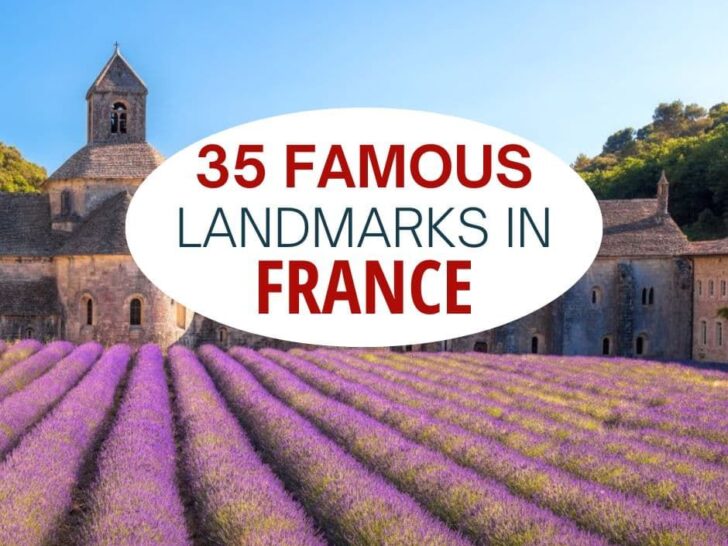
11. The Senanque Abbey and the lavender fields (Gordes)
Another world-famous French landmark, Senanque, is a Cistercian abbey located close to the village of Gordes in Vaucluse.
The building dates back to 1148.
The whole structure of the abbey features good examples of Romanesque architecture, which is austere and has clean lines.
Today, Senanque Abbey is among the most popular places in France to visit the blossoming lavender fields during June and July.

12. Citadel of Carcassonne (Carcassonne)
The Cité de Carcassonne is a medieval citadel in the Occitanie region of France.
The fortified town stands on top of a hill near the Aude River, and it is another of the many UNESCO World Heritage Sites in France.
Highlights of the fortified medieval town include a three-kilometer-long double surrounding walls with over 50 towers with a semicircular plan and over 14 meters high.
Founded during the Gallo-Roman period, over the centuries, the city was occupied by different civilizations, including the Romans and Visigoth but also the Crusaders.
13. Pont du Gard Roman Aqueduct (Gardon River, Nimes)
Dating back to the first century AD, the Pont du Gard is an ancient Roman aqueduct bridge built to carry water for more than 50 kilometers to the Roman city of Nimes.
The bridge spans over the Gardon River in southern France.
Pont du Gard is the tallest and best-reserved Roman aqueduct of all time and is also listed as a UNESCO World Heritage Site.

14. Notre Dame de Fourvière Basilica (Lyon)
Built respecting the Romanesque and Byzantine architectural styles, the most important church in the French city of Lyon, Notre Dame de Fourvière, was built between 1872 and 1896 on the place where once stood the Old Roman Forum of Trajan (Fourvière is, in fact, a corruption of the French expression for old fort).
The church is dedicated to the Virgin, who is thought to have saved Lyon from the terrible plague that castigated Europe back in 1643.
The basilica is perched on top of a hill, and it is a beloved symbol of the city. From its north tower, the views of Lyon are impressive.
15. Mont Saint Michel (Normandy)
A World Heritage Site and popular landmark in France, Mont Saint Michel is a tidal island only surrounded by water two times a year (summer and winter solstices) located in Normandy, France.
The island lies about one kilometer off the coast and covers an area of 17 acres.
Once an important medieval Christian site, the commune houses over 60 buildings, all of them defined as historic monuments of France.
During the visit, don’t overlook the ramparts and the old village, the different museums, and the spectacular Benedictine abbey dedicated to the Archangel Saint Michael.
16. Versailles Palace & Gardens (Yvelines, Ile-de-France)
Locally known as the Château de Versailles, the magnificent French palace and museum was built back in the seventeenth century and worked for years as the Royal Residence of France, where the court was established during the reign of King Louis XIV.
The place, which originally started as a hunting lodge for Louis XIII, was transformed into a lavish palace with dozens of luxurious halls and rooms by his successor, Louis XIV.
Although the palace was abandoned and left to decay during the French Revolution, it was later refurbished and opened to the public.
The palace is surrounded by splendid French gardens with dozens of lush labyrinths and stunning ponds and statues.
Today, Versailles is owned by the French Republic and listed as a World Heritage Site by UNESCO.

17. Omaha Beach (Normandy)
Sadly known due to the events that took place during WWII, Omaha Beach was one of five beach landing sectors designated for an impressive amphibious assault that took place in June 1944 when the Allies invaded the German-occupied country in the Normandy region.
The beach in Omaha extends for 8 kilometers, facing the English Channel. The Allied assault encountered strong defenses from the Germans, who inflicted terrible damage and provoked thousands of casualties among the US troops.
Today, overlooking the beach, it is possible to visit the American Cemetery, located at the top of the bluff overlooking Omaha, near the small settlement of Colleville-Sur-Mer.

18. Basilica of Our Lady of Amiens (Amiens)
Another fantastic Gothic structure, this time in the Picardy region, about 120 kilometers north of Paris, Amiens Cathedral is located facing the Somme River.
It was built between 1220 and 1270, a time that many refer to as very short for a Gothic cathedral, especially when considering the impressive dimensions of the religious church.
Considered a unique example of High Gothic, the church is the largest cathedral in France, so much so that it could even contain Notre Dame of Paris… twice!
As would be expected, the cathedral is another French monument listed as a UNESCO World Heritage Site with impressive stained glass and an incredible number of early Gothic sculptures.
19. Gardens of Monet (Giverny)
Known as Maison et Jardins de Claude Monet, this visit is a great day trip from Paris for those interested in Monet’s paintings as well as keen on discovering exquisite open spaces and blossoming gardens.
The former house of the painter is in Giverny, close to Paris (75 km.) and Rouen.
The pink-pastel house and museum were home to the artist for the last 40 years of his life; it was the place where he got the inspiration to paint the famous Water Lilies.
On the premises, it is possible to visit the Water Garden (Jardin d’Eau) and a famous Japanese Bridge adorned with purple wisteria, daffodils, tulips, and other colorful flowers that change according to the seasons.

20. Saint-Étienne Cathedral (Metz)
Located in the spectacular capital of Lorraine, Metz is an ancient town displaying one of the most spectacular Gothic churches in the country, Saint-Étienne Cathedral.
Visible from almost any spot in town, the unique Gothic spires of Saint-Étienne have long been one of the most important landmarks in the region.
Dubbed God’s Lantern for the incredibly beautiful stained glass decorations and Chagall windows featuring an impressive display of light and color that create a truly unique atmosphere inside the temple.
When visiting, don’t miss the fifteenth-century crypt and the sculpture of the Graully, a pre-Christian dragon closely intertwined with the history of Metz.
21. Château de la Duchesse Anne (Dinan)
Often simply known as the Château de Dinan, this incredible landmark and historical monument is a traditional medieval fortified keep located in the Brittany Region.
The imposing castle dating back to the 1380s stands over 34 meters high and features over 2600 meters of medieval ramparts.
The structure presents two imposing circular towers as well as a magnificent drawbridge that separates the castle from the outside world.
You can check out a fantastic video of the landmark and discover more to visit at the official site of the Château de la Duchesse Anne.
22. Reims Underground Tunnels (Reims)
Although most people visit Reims to discover the champagne produced in the region, there is a hidden gem in Reims that shouldn’t be missed, its incredible underground tunnels.
Under the lush vineyards of Champagne, there is a different world made of hundreds of miles of subterranean caves and complex tunnels dating from Roman times, which used to be the ideal, dark place where countless bottles of champagne would rest and mature.
This impressive subterranean complex also functioned as an underground city during the most difficult years of WWI.
23. Notre Dame de Reims Cathedral (Reims)
One more incredible Gothic cathedral in France, Notre Dame de Reims, is a UNESCO World Heritage Site over 800 years old and worth a stop during your visit to Reims.
The construction of the building began back in 1211, and it houses a precious Gothic organ case, a famous statue of Joan d’Arc, as well as a unique wooden astronomical clock from the fifteenth century.
Inside the building, the colorful rainbows of light that decorate the walls and columns are produced by the incredibly beautiful stained-glass windows.
The cathedral is famous for being the place where Charles VII was coronated king of France while Joan d’Arc was standing by his side.
24. Loire Valley Châteaux
Home to over three hundred castles, the Loire Valley is home to a collection of unique castles ranging from simple fortified structures to some of the most stunning palaces in France.
The architectural heritage of this vast area includes fortifications in different historic towns, such as Angers, Orleans, Tours, Angers, and other settlements standing along the Loire River.
From the tenth century until the years of the Renaissance and beyond, the area became home to different French kings, nobility, and rich citizens.
The Loire turned into an important seat of power, adorned with some impressive landscapes, French gardens, cultural monuments, and several châteaux built on scenic hilltops and offering stunning views of the valley.
One of the most impressive castles, the Château Aubry d’Amboise, is a historic monument of France, and it was also the place where King Charles VIII died after hitting his head on a door lintel in the castle.

25. Krutenau Quarter (Colmar)
Known as Alsace’s Little Venice, the charming Krutenau District is located only steps from the historic district of Colmar in the Alsace region.
The tranquil district features a selection of half-timbered houses standing right next to the Lauch River, which extends for over forty kilometers, heading into the Alsace Plain.
Like in many other French settlements, close to the stream you can explore the Rue des Tanneurs, a bohemian hideout now full of bars and coffee shops, which in the past was where local tanners would work and live.
Rowboats to explore La Petite Venise depart from Pont Rue de Turenne and offer the perfect way to see the most traditional and picturesque area of Colmar.
26. La Petit France (Strasbourg)
Looking for one more charming Alsatian village? Then La Petit France has all the answers!
This beautiful quarter in the heart of Strasbourg is another must-visit in France.
Often compared to Venice for its canals and houses built next to the delta of the river, this neighborhood is made of colorful buildings and picturesque townhouses with balconies and windows decorated with dozens of bushes and flowers.
These townhouses are located at the mouth of the River Ill. The historic district is the city’s oldest area, dating back to the sixteenth century, when it was inhabited by fishermen, merchants, and tanners.
Taking a boat tour in the area is an ideal activity to explore the different bridges as well as the covered passages that add a charming atmosphere to the settlement.
27. La Grosse Cloche (Bordeaux)
Translated as the big bell, La Grosse Cloche is a huge bell situated in the heart of the city of Bordeaux.
This unique French landmark is another attraction that you should not miss on any South France itinerary.
Located on a prominent part of the old ramparts of the city of Bordeaux, the structure features three impressive towers as well as an amazing clock mechanism located beneath the huge bell.
Bordeaux Grosse Cloche has been marking the rhythm of the city since the thirteenth century, and it rings a few times every year, including Bastille Day and Remembrance Day.

28. Le Vieux Port (Marseille)
One of the oldest ports in France and Europe, the Old Port of Marseille is an atmospheric place in town.
Located facing the incredible Notre Dame de La Garde Basilica, this is the actual place that saw the birth of Marseille as a prosperous trading center, a status that the city has kept for centuries.
The area is famous for the dozens of fishing boats, yachts, and touristic boats that dock in the impressive harbor, guarded by the forts of Saint Nicholas and Saint Jean.
Today, however, the area is the must-go place in Marseille to discover the best local brasseries and restaurants specializing in the delicious Bouillabaisse, the city’s famous fish soup.
The area around the port is also the perfect place to buy the catch of the day and a unique departure point to visit the colorful Le Panier neighborhood and its vivid graffiti collection.
29. Avenue de Champagne (Épernay)
Head to Épernay, the capital of Champagne in the Grand Est region of France, to visit this major historical trade route that connects France and Germany.
Today, over here, you will find a series of leading champagne producers, including famous brands such as Mercier or Moët et Chandon.
Since the eighteenth century, this avenue has attracted champagne merchants who established their shops and cellars, making it one of France’s top tourist attractions.
Locals claim that Avenue de Champagne is authentically the most expensive road in the world, as it shelters millions of champagne bottles along extensive underground chalk cellars.
The avenue (both over and underground) has been listed on the UNESCO World Heritage List.
30. Jardins de la Fontaine (Nimes)
Over 15 hectares of gorgeous gardens stand on top of a hill in the heart of the city of Nimes, in Provence.
The landscapes include an impressive classic garden from the eighteenth century as well as a Mediterranean garden.
The place dates back to 1745, when King Louis XV ordered its construction.
Inspired by the most famous French gardens in the country, the different natural compositions include symmetric alleys, paths lined with trees, and unique ornaments and decorations such as vases, columns, and stone benches.
31. Promenade des Anglais (Nice)
Nice is one of the most prestigious coastal towns in the south of France, home to the rich and the famous, especially during the summer season.
And there is one place in town where everyone goes to witness the magnificent Nice sunset: the Promenade des Anglais.
Translated as the English Walkway, this famous seaside pedestrian road spreads for over seven kilometers along the Mediterranean coast of Nice, connecting Nice Airport to the United States Quay.
The promenade got its name from the English aristocracy who would spend the winters in Nice, especially in the second half of the eighteenth century.
Today is known as La Prom, and it is the place to be when in Nice!

32. La Cité du Vin (Bordeaux)
If modern structures attract your attention more than ancient castles and dreamy gardens, then head to La Cité du Vin for a completely different experience.
A place especially treasured by wine lovers, the city of wine is a state-of-the-art structure made of metal and glass in the heart of the city of Bordeaux.
Over here, it’s possible to taste, enjoy, and learn all the essentials about wine!
Managed by the Foundation for Wine Culture and Civilizations, the place’s main goal and mission is to protect, celebrate, and transmit the heritage of wine.
You can find out more on the official La Cité du Vin website.
33. Le Sentier des Ocres (Roussillon)
You won’t find as many romantic natural places as the Sentier des Ocres in French Provence.
Part of the Luberon village of Roussillon, the path takes you to explore spectacular landscapes where the color ochre is the leading character.
A guided tour along any of the two walking trails offers a 360-degree panorama of the local geology and vegetation. Learn about the history of the ochre massif of the Luberon, home to this unique natural pigment over 110 million years old!

34. Parc National des Calanques
If you’re in France to discover imposing natural scenarios, head to the Calanques, and you won’t be disappointed.
The Calanques National Park is located a few minutes by boat from the Old Port of Marseille, on the Mediterranean coast in Bouches-du-Rhône, and a few kilometers from Cassis.
The breathtaking cliffs of the Calanques feature an impressive collection of pebble and fine sandy beaches and calm turquoise waters, perfect to swim, sunbathe, go snorkeling, or enjoy other popular water sports.
The place is also a paradise for those who enjoy trekking and hiking.
35. Mont Blanc
One of the most famous peaks in the world, Mont Blanc (meaning white mountain), is the highest mountain in the Alps, rising more than 4,800 meters.
The Mont Blanc massif stands between France, Italy, and Switzerland, while ownership of its summit has long been part of a border dispute between Italy and France.
Arguably one of the most popular winter sports locations in Europe, Mont Blanc is the best place to enjoy many outdoor activities, including climbing, trail running, hiking, skiing, and snowboarding.
Climbing to the summit following the popular Goûter Route typically takes two days and should be done with an organized tour.
The most famous French towns in the area are Saint Gervais Les Bains and Chamonix, where the first Winter Olympics were held in Europe in 1924.

Save this to Pinterest for later!

About the Author
 Gabi Ancarola is a translator and travel journalist living in Crete. She regularly writes about Europe for several magazines about travel, gastronomy, and hospitality. She has published several travel guides about Greece and plans customized trips to the Greek islands. She loves cooking local dishes, taking photos, and driving on the mountain roads of Crete.